
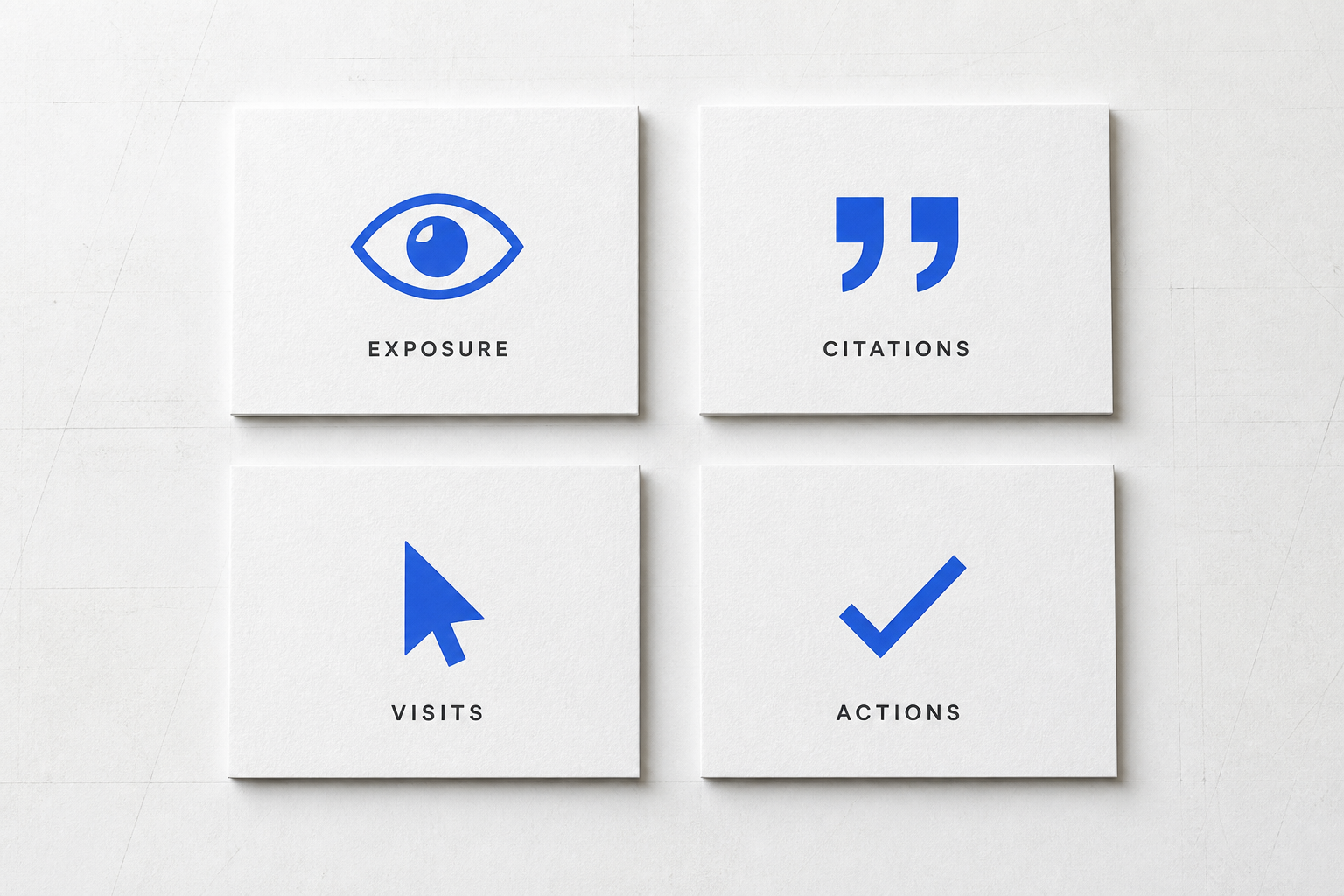
Give each number one job
- Search exposure: record Search Console impressions and clicks separately. Impression counting depends on the result format; an impression is not a visit. 2
- AI citations: Bing AI Performance reports source citations across supported Microsoft and partner experiences. Its grounding-query rows are a sample of retrieval phrases, not a complete account of user questions. 3
- Referral sessions: if analytics is configured, record sessions attributed to each observed AI source. In GA4, use Traffic acquisition and Session source / medium, rather than first-user acquisition. 5
- Useful actions: choose one event your site can actually record, such as a completed signup or dataset download. Write its definition down. A download records access, not proof that someone used the data.
Google includes AI Overviews and AI Mode in Search Console's Web reporting. Treat that total as Google Search performance, not an AI-only traffic count. Keep it separate from your manually observed answers. 1
Copy this weekly worksheet
Choose one page or a fixed page group. Use a completed seven-day window, record each tool's reporting cutoff and timezone, and compare only matching coverage. Keep the original row when later data changes it.
- Scope: page URLs; week; timezone; filters; export date; data available through.
- Search: Google Web impressions; clicks; any missing dates.
- Citations: Bing citation count; cited URLs; report scope; unavailable fields.
- Visits: observed session source / medium; sessions; landing page; attribution unknowns.
- Actions: event definition; sessions with that event; measurement start date.
- Decision: one observation; one uncertainty; one next check; next review date.
Use not measured when tracking is absent and pending when a report is unfinished. Reserve zero for an available measurement that reports zero. Do not divide sessions from one provider by citations covering several providers, or add these columns into a visibility score.
Add a small, repeatable answer check
For a manageable starting sample, write eight questions: two each about a problem, a how-to task, a comparison and a fact to verify. Keep branded questions separate from unbranded questions. This is a suggested routine, not a representative survey.
- Freeze the exact wording for four weeks. Run each question twice a week on the same named product, using a fresh conversation each time. Keep each product's results separate.
- Record the date, product, displayed model if available, language, region and signed-in state. If a setting is hidden, write unknown. Do not store account identifiers or sensitive prompts.
- For each answer, record whether it names the brand, links to your domain, cites a particular page and represents the page accurately. A mention without a link stays a mention.
- Keep a short observation and the exact cited URL. Record failures and unavailable answers; do not silently replace them with more favorable runs. Report completed and attempted checks.
- Changing a question starts a new prompt-set version. Report results separately until the comparison uses the same questions and conditions again.
A hypothetical result might read: three of sixteen completed answers linked to the site; sixteen checks attempted. That describes this sample only. Repeated runs do not turn it into market share.
This fraction is also different from Bing's Citation Share, which uses citations for a grounding query as its denominator. Microsoft explicitly distinguishes that metric from traffic share. 4
Use the gap to choose the next check
- Citations rise, recorded visits stay flat: inspect the linked pages and how the answer describes them. Check attribution before deciding that readers are choosing not to click.
- Visits rise, useful actions stay flat: test that the event fires correctly, then inspect whether the landing page helps the visitor complete the intended task.
- Everything moves after an edit: log the edit and compare another matching window. Timing alone cannot establish that the edit caused the change.
End the review with one decision, such as fixing a broken citation destination or clarifying an incomplete answer. None of these observations promises a ranking improvement.
Keep a source note beside the numbers
Platform definitions here were checked on 30 August 2026. Google and Microsoft describe their own reports; these are not independent effectiveness studies. 1 3 4
When borrowing a creator's tactic, use Base2026's source-diversity check to separate repeated records from distinct viewpoints. The AI visibility topic page offers claims to investigate, not proof that those tactics work. 8 9
Base2026's methodology explains attribution and original-source checks. Its dataset page distinguishes dated static files from the live evidence index. Preserve those dates when building your own research note. 6 7
Sources and checks
Links support the statements cited above. Different URLs do not automatically mean independent evidence.
- AI features and your website
- What are impressions, position, and clicks?
- Introducing AI Performance in Bing Webmaster Tools Public Preview
- Traffic acquisition report
- Base2026 Methodology
- Base2026 Public Video Research Dataset
- Three Sources Are Not Always Three Independent Voices
- AI visibility and answer readiness creator evidence